Enlightenment in Poland
| Part of a series on the |
| Culture of Poland |
|---|
 |
History
|
People |
Languages
|
Traditions |
Mythology and folklore
|
Cuisine |
Festivals |
Religion |
Art
|
Literature
|
Music and performing arts
|
Media
|
Sport |
Monuments
|
Symbols
|
|
 Poland portal
The ideas of the Age of Enlightenment in Poland were developed later than in Western Europe, as the Polish bourgeoisie was weaker, and szlachta (nobility) culture (Sarmatism) together with the Polish-Lithuanian Commonwealth political system (Golden Liberty) were in deep crisis. The period of Polish Enlightenment began in the 1730s–40s, peaked in the reign of Poland's last king, Stanisław August Poniatowski (second half of the 18th century), went into decline with the Third Partition of Poland (1795) – a national tragedy inspiring a short period of sentimental writing – and ended in 1822, replaced by Romanticism.[1]
Contents
1 History
1.1 Constitution of 1791
2 Notable persons
3 Architecture
4 See also
5 Notes
6 Further reading
History
Polish Enlightenment, while sharing many common qualities with the classical Enlightenment movements of Western Europe, also differed from them in many important aspects. Much of the thought of the Western Enlightenment evolved under the oppressive absolute monarchies and was dedicated towards fighting for more freedom. Western thinkers desired Montesquieu's separation and balance of powers to restrict the nearly unlimited power of their monarchs. Polish Enlightenment, however, developed in a very different background. The Polish political system was almost the opposite of the absolute monarchy: Polish kings were elected and their position was very weak, with most of the powers in the hands of the parliament (Sejm). Polish reforms desired the elimination of laws that transformed their system into a near-anarchy, resulting from abuse of consensus voting in Sejm (liberum veto) that paralyzed the Commonwealth, especially during the times of the Wettin dynasty, reducing Poland from a major European player to the puppet of its neighbours. Thus, while men of the Enlightenment in France and Prussia wrote about the need for more checks and balances on their kings, Polish Enlightenment was geared towards fighting the abuses stemming from too many checks and balances.

Portrait of the Prozor Family by Franciszek Smuglewicz, 1789
The differences did not end there. Townsfolk and bourgeoisie dominated Western Enlightenment movement, while in the Commonwealth most of the reformers came from szlachta (nobility). Commonwealth szlachta (forming the 10% of its population) considered the idea of equality to be one of the foundations of its culture, and reformers fought to expand it towards other social classes. Religious tolerance, was an ideal of the szlachta.
Constitution of 1791
Ideas of that period led eventually to one of the greatest achievements of Poland, the Constitution of May 3, 1791 (second-oldest world constitution) and other reforms (like the creation of the Commission of National Education, first ministry of education in the world) which attempted to transform the Commonwealth into a modern constitutional monarchy. Although attempts of political reform were thwarted by the civil war (Targowica Confederation) and military intervention of the Commonwealth neighbour, ending in the partitions of Poland, the cultural impact of that period persevered Polish culture for many years.[1]

Załuski Library, the first public library in Poland, under construction. 1801 watercolor by Zygmunt Vogel. National Museum, Warsaw
The ideas of the Polish Enlightenment had also significant impact abroad. From the Bar Confederation (1768) through the period of the Great Sejm and until the aftermath of the Constitution of May 3, 1791, Poland experienced a large output of political, particularly constitutional, writing.
Important institutions of the Enlightenment included the National Theatre founded in 1765 in Warsaw by King Stanisław August Poniatowski; and in the field of advanced learning: the Commission of National Education established by the Sejm in 1773; the Society for Elementary Books; as well as the Corps of Cadets (Knight's military school) among others. In expanding the field of knowledge, there was the Society of Friends of Science set up in 1800 soon after the Partitions. Popular newspapers included Monitor and Zabawy Przyjemne i Pożyteczne (Games Pleasant and Useful).
Notable persons
Wojciech Bogusławski - father of Polish theater
Franciszek Bohomolec - poet, writer, publisher, teacher
Tadeusz Czacki - education, economy, founder of Towarzystwo Przyjaciół Nauk and Liceum Krzemienieckie
Joachim Chreptowicz - Last Grand Chancellor of the Lithuania, journalist, poet, translator, and physiocrat
Jakub Jasiński - poet, general, radical supporter of revolution
Franciszek Salezy Jezierski - writer, political activist
Franciszek Karpiński - poet
Franciszek Kniaźnin (Franciszek Dionizy Kniażin) - poet, writer
Hugo Kołłątaj - priest, social and political activist, political thinker, historian and philosopher
Stanisław Konarski - precursor of education reform, author of O skutecznym rad sposobie
Onufry Kopczyński - teacher, precursor of Polish grammar
Michał Dymitr Krajewski - writer, educational activist
Ignacy Krasicki - one of Poland's greatest poets, writer, bishop, co-organiser of Thursday dinners
Stanisław Leszczyński - king of Poland, political activist, writer (Głos wolny wolność ubezpieczający)
Samuel Bogumił Linde - chairman of Towarzystwo do Ksiąg Elementarnych, creator of Słownik Języka Polskiego
Adam Naruszewicz - poet, translator, historian
Julian Ursyn Niemcewicz - poet, playwright, independence activist
Jan Piotr Norblin - painter
Józef Maksymilian Ossoliński - writer, social, science and cultural activist, founder of Zakład Narodowy im. Ossolińskich
Grzegorz Piramowicz - writer, philosopher, educational activist
Stanisław August Poniatowski - king, co-organiser of Thursday's dinners, great supporter of arts and sciences in Poland,
Stanisław Staszic - writer, economist
Jan Śniadecki - astronomer, mathematician, philosopher
Jędrzej Śniadecki - chemist
Stanisław Trembecki - poet (Classicism style)
Tomasz Kajetan Węgierski - poet, explorer
Józef Wybicki - political activist, author of the words of Mazurek Dąbrowskiego, Polish national anthem
Franciszek Zabłocki - poet, comedy writer, secretary of Towarzystwo do Ksiąg Elementarnych
Andrzej and Józef Załuski - founders of first Polish public library, Biblioteka Załuskich
Andrzej Zamoyski - kanclerz, politician, author of the Zamoyski Code
Architecture

Roman theater on the Isle (1790-1793), a companion to the Palace on the Water.
The center of the neoclassical architecture in Poland was Warsaw under the reign of Stanisław August Poniatowski.[2]Classicism came to Poland in the 18th century. The best known architects and artists, who worked in Poland were Dominik Merlini, Jan Chrystian Kamsetzer, Szymon Bogumił Zug, Stanisław Zawadzki, Efraim Szreger, Antonio Corazzi, Jakub Kubicki, Christian Piotr Aigner, Wawrzyniec Gucewicz and Bertel Thorvaldsen.
The first stage, called the Stanislavian style, followed by an almost complete inhibition and a period known as the Congress Kingdom classicism.[3] The most famous buildings of the Stanislavian period include the Royal Castle in Warsaw, rebuilt by Dominik Merlini and Jan Christian Kamsetzer, Palace on the Water, Królikarnia and the palace in Jabłonna.
From the period of the Congress Kingdom are Koniecpolski Palace and the St. Alexander's Church in Warsaw, the Temple of the Sibyl in Puławy, rebuilding the Łańcut Castle. The leading figure in the Congress Kingdom was Antoni Corrazzi.[4] Corazzi has created a complex of Bank Square in Warsaw, the edifices of the Treasury, Revenue and the Commission of Government, the building of the Staszic Palace, Mostowski Palace and designed the Grand Theatre.
- Palaces

Łazienki Palace in Warsaw, 1764-1795
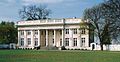
Marynka Palace in Puławy, 1790-1794

Królikarnia Palace in Warsaw, 1782-1786
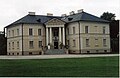
Gorzeński Palace in Dobrzyca, 1795-1799

Presidential Palace in Warsaw, 1818
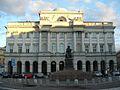
Staszic Palace in Warsaw, 1820-1823
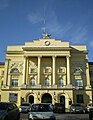
Mostowski Palace in Warsaw, 1823-1824

Czartoryski Palace in Puławy, 1840-1843


- City structures

Działyński House in Poznań, 1773-1776
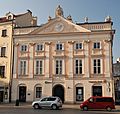
Zbaraski House in Kraków, 1777-1783
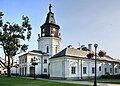
Town Hall in Siedlce, 1766-1769

Guard Building, 1783-1787
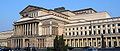
Great Theatre in Warsaw, 1825-1833

Commission Palace in Warsaw, 1823-1825

Ministry of Treasury in Warsaw, 1825-1828
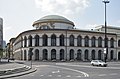
Polish Bank in Warsaw, 1825–28


See also
- History of philosophy in Poland
Notes
^ ab Jerzy Snopek, "The Polish Literature of the Enlightenment." Archived 2011-10-05 at the Wayback Machine. (PDF 122 KB) Poland.pl. Retrieved October 7, 2011.
^ John Stanley (March–June 2004). "Literary Activities and Attitudes in the Stanislavian Age in Poland (1764–1795): A Social System?". findarticles.com. Retrieved 2009-04-23..mw-parser-output cite.citation{font-style:inherit}.mw-parser-output q{quotes:"""""""'""'"}.mw-parser-output code.cs1-code{color:inherit;background:inherit;border:inherit;padding:inherit}.mw-parser-output .cs1-lock-free a{background:url("//upload.wikimedia.org/wikipedia/commons/thumb/6/65/Lock-green.svg/9px-Lock-green.svg.png")no-repeat;background-position:right .1em center}.mw-parser-output .cs1-lock-limited a,.mw-parser-output .cs1-lock-registration a{background:url("//upload.wikimedia.org/wikipedia/commons/thumb/d/d6/Lock-gray-alt-2.svg/9px-Lock-gray-alt-2.svg.png")no-repeat;background-position:right .1em center}.mw-parser-output .cs1-lock-subscription a{background:url("//upload.wikimedia.org/wikipedia/commons/thumb/a/aa/Lock-red-alt-2.svg/9px-Lock-red-alt-2.svg.png")no-repeat;background-position:right .1em center}.mw-parser-output .cs1-subscription,.mw-parser-output .cs1-registration{color:#555}.mw-parser-output .cs1-subscription span,.mw-parser-output .cs1-registration span{border-bottom:1px dotted;cursor:help}.mw-parser-output .cs1-hidden-error{display:none;font-size:100%}.mw-parser-output .cs1-visible-error{font-size:100%}.mw-parser-output .cs1-subscription,.mw-parser-output .cs1-registration,.mw-parser-output .cs1-format{font-size:95%}.mw-parser-output .cs1-kern-left,.mw-parser-output .cs1-kern-wl-left{padding-left:0.2em}.mw-parser-output .cs1-kern-right,.mw-parser-output .cs1-kern-wl-right{padding-right:0.2em}
^ Manfred Kridl (1967). A survey of Polish literature and culture. Columbia University Press. pp. 192, 343.
^ Wojciech Słowakiewicz (2000). Wielka encyklopedia polski (in Polish). Fogra.
Further reading
- Butterwick, Richard. "What Is Enlightenment (Oswiecenie)? Some Polish Answers, 1765-1820," Central Europe, May 2005, Vol. 3 Issue 1, pp 19–37. online[dead link]
Fiszman, Samuel; Jan Kochanowski (1988). The Polish renaissance in its European context. Indiana U.P.
Janowski, Maciej (2004). Polish Liberal Thought Before 1918. Central European University Press.
Suchodolski, Bogdan (1986). A history of Polish culture. Interpress Publishers.
- Stanley, John "Towards A New Nation: The Enlightenment and National Revival in Poland," Canadian Review of Studies in Nationalism, 1983, Vol. 10 Issue 2, pp 83–110
The Age of Enlightenment | |||||||||||||||||||||||||||||||||
|---|---|---|---|---|---|---|---|---|---|---|---|---|---|---|---|---|---|---|---|---|---|---|---|---|---|---|---|---|---|---|---|---|---|
| |||||||||||||||||||||||||||||||||
| |||||||||||||||||||||||||||||||||
| |||||||||||||||||||||||||||||||||
 Category
 Portal

