This article is about Idris I of Morocco. For information on Idris I of Libya, see Idris of Libya. For information on Idris I of the Kanem Empire, see Idris I of Kanem.
Idris I إدريس الأول
Emir of Morocco
Reign
788–791
Coronation
Emir of Morocco
Successor
Idris II
Born
745
Died
791
Burial
Moulay Idriss Zerhoun
Spouse
Kenza al-Awrabiya
Full name
Idris ibn Abdullah
Dynasty
Idrisid
Father
Abdullah al-Kamil
Mother
'Atika bint Abdulmalik
Idris I (Arabic: إدريس الأول), also known as Idris ibn Abdillah, was the founder of the Idrisid dynasty in part of northern Morocco in alliance with the Berber tribe of Awraba. He ruled from 788 to 791. He is credited with founding the dynasty that established Moroccan statehood and is regarded as the "founder of Morocco".[1] He was the great-great-great-grandson of the Islamic Prophet Muhammad.
Contents
1History
2See also
3Notes
4External links
5References
History
Idris was the great-grandchild of Hasan, who was the son of Fatimah and grandson of the Islamic prophet, Muhammad. His brothers Muhammad al-Nafs al-Zakiyya and Ibrahim had been killed by the Abbasids during an abortive rebellion, and Idris himself escaped after the defeat of another Alid uprising at the Battle of Fakhkh in 786 and took refuge in the western Maghreb (nowadays Morocco). There he established the Arabian Idrisid dynasty.
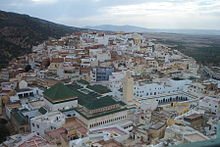
The Tomb of Idris I (green roofed structure, bottom left) in Moulay Idris
In 789 arrived in Walīla, the site of the Roman Volubilis where he founded the town of Moulay Idriss near the hill of Zerhoun surrounding the native Berber tribes. It was then occupied by the Berber tribe of the Awraba, under Ishaq ibn Mohammed. He married Kenza, daughter of Ishaq ben Mohammed the king of the tribe, fathering a son, Idris II. This event is considered a consolidation and the birth of the Idrisid dynasty, the fourth Muslim State in Morocco after Nekor (710 - 1019), Barghawata (744 - 1058), and Midrar (757 - 976).
Idris I conquered large parts of northern Morocco, his son Idris II made Fez the capital city of the Idrisid dynasty. In 789 AD, he captured Tlemcen[citation needed] (modern day Algeria) which became part of the kingdom. This succession of events prompted vengeance from the Abbasid caliph Harun al-Rashid, who sent emissaries to kill him. Idris I was poisoned and died in 791. His son, Idris II, was brought up by the Awraba, and left Walīla for Fes in 808. Idris is buried in Moulay Idriss.
See also
Idris II of Morocco
Idrisid dynasty
History of North Africa
Moulay Idriss Zerhoun
North African Arabs
Notes
^A History of the Maghrib in the Islamic Period, Jamil M. Abun-Nasr, 1987, p. 52
External links
(in French) The exile of Mulay Idris to the Maghreb and his assassination (at-tawhid.net)
(in Arabic)Muslim rulers at hukam.net
References
Julien, Charles-André, Histoire de l'Afrique du Nord, des origines à 1830, original edition in 1931, new edition by Payot, Paris, 1994
Abum-Nasr, Jamil M. (1987). A History of the Maghrib in the Islamic Period.
Preceded by New creation
Idrisid dynasty 788–791
Succeeded by Idris II
v
t
e
Rulers of Morocco
Idrisid dynasty (788–974)
Idris I (Idris ibn Abdallah)
Idris II (Idris ibn Idris)
Muhammad ibn Idris
Ali I (Ali ibn Muhammad)
Yahya I (Yahya ibn Muhammad)
Yahya II (Yahya ibn Yahya)
Ali II (Ali ibn Umar)
Yahya III (Yahya ibn al-Qasim)
Yahya IV (Yahya ibn Idris ibn Umar)
Al-Hasan ibn Muhammad
Al-Qasim ibn Ibrahim
Ahmad ibn al-Qasim
Al-Hasan ibn al-Qasim
Almoravid dynasty (1040–1147)
Yusuf ibn Tashfin
Ali ibn Yusuf
Tashfin ibn Ali
Ibrahim ibn Tashfin
Ishaq ibn Ali
Almohad dynasty (1121–1269)
Abd al-Mu'min
Yusuf I (Abu Yaqub Yusuf)
Yaqub al-Mansur
Muhammad al-Nasir
Yusuf II (Yusuf al-Mustansir)
Abd al-Wahid I (Abd al-Wahid al-Makhluʿ)
Abdallah al-ʿAdil
Yahya al-Mu'tasim
Idris al-Ma'mun
Abd al-Wahid II
Said al-Muʿtadid
Marinid dynasty (1244–1465)
Abubakr ibn Abd al-Haqq
Yaqub ibn Abubakr
Yusuf ibn Yaqub
Amir ibn Abdullah
Sulayman ibn Abdullah
Uthman ibn Yaqub
Ali ibn Uthman
Faris ibn Ali
Muhammad ibn Faris
Abubakr ibn Faris
Ibrahim ibn Ali
Tashfin ibn Ali
Abd al-Aziz ibn Ali
Muhammad ibn Abd al-Aziz
Ahmad ibn Ibrahim (al-Mustansir)
Musa ibn Faris
Muhammad ibn Ahmad (al-Wathiq)
Ahmad ibn Ibrahim (al-Mustansir)
Abd al-Aziz ibn Ahmad
Abdallah ibn Ahmad
Uthman ibn Ahmad
Abd al-Haqq ibn Uthman
Idrisid interlude (1465–1471)
Muhammad ibn Ali Amrani-Joutey
Wattasid dynasty (1471–1549, 1554)
Muhammad ibn Yahya
Muhammad ibn Muhammad
Ali ibn Muhammad (Abu Hassun)
Ahmad ibn Muhammad
Muhammad ibn Ahmad
Saadi dynasty (1549–1659)
Muhammad ash-Sheikh
Abdallah al-Ghalib
Muhammad al-Mutawakkil
Abd al-Malik I (Abu Marwan Abd al-Malik al-Ghazi)
Ahmad al-Mansur
Abu Faris Abdallah
Zidan al-Nasir
Abd al-Malik II (Abu Marwan Abd al-Malik ibn Zidan)
Electric locomotive Škoda ChS4-109. The Moscow — Odessa train in Vinnytsia railway station. The Siemens ES64U4, is the current confirmed holder as the fastest electric locomotive at 357 km/h (222 mph) in 2006. An electric locomotive is a locomotive powered by electricity from overhead lines, a third rail or on-board energy storage such as a battery or a supercapacitor. Electric locomotives with on-board fueled prime movers, such as diesel engines or gas turbines, are classed as diesel-electric or gas turbine-electric and not as electric locomotives, because the electric generator/motor combination serves only as a power transmission system. Electric locomotives benefit from the high efficiency of electric motors, often above 90% (not including the inefficiency of generating the electricity). Additional efficiency can be gained from regenerative braking, which allows kinetic energy to be recovered during braking to put power back on the line. Newer electric locomotives ...
Carlow County Council Comhairle Contae Cheatharlach Type Type County council Leadership Cathaoirleach Brian O'Donoghue, FG Structure Seats 18 Political groups Fine Gael (6) Fianna Fáil (5) Sinn Féin (3) Labour Party (2) Independent (2) Elections Last election 23 May 2014 Meeting place County Buildings, Carlow Website carlow.ie The area governed by the council Carlow County Council (Irish: Comhairle Contae Cheatharlach ) is the authority responsible for local government in County Carlow, Ireland. As a county council, it is governed by the Local Government Act 2001. The council is responsible for housing and community, roads and transportation, urban planning and development, amenity and culture, and environment. [1] The council has 18 elected members. Elections are held every five years and are by single transferable vote. The head of the council has the title of Cathaoirleach (Chairperson)....
Abdulla Qahhor A commemorative Uzbek stamp made in honor of Abdulla Qahhor's 100th birthday Born Abdulla Qahhorov ( 1907-09-17 ) September 17, 1907 Kokand Russian Turkestan Died May 25, 1968 (1968-05-25) (aged 60) Moscow Russian Soviet Federative Socialist Republic Occupation Novelist, short story writer, poet, playwright, and literary translator Literary movement Realism Notable awards State Stalin Prize (1952) National Writer of the Uzbek SSR (1967) National Order of Merit (2000) Abdulla Qahhor (sometimes spelled Abdulla Kahhar in English) (Uzbek: Abdulla Qahhor, Абдулла Қаҳҳор ) (September 17, 1907 – May 25, 1968) was an Uzbek novelist, short story writer, poet, playwright, and literary translator. He is best remembered as the author of the 1951 novel Qoʻshchinor chiroqlari ( The Lights of Qoʻshchinor ) and the 1958 story Sinchalak . In addition to writing numerous short stories and novels, Qahhor translated the works of many famous R...