Papuan people
Orang Papua | |
|---|---|
 Children dressed up for sing-sing | |
| Regions with significant populations | |
 Papua New Guinea Papua New Guinea | |
 Indonesia Indonesia | 2,693,630[1] |
 United States United States | 6,000 |
 Canada Canada | 1,500 |
 Australia Australia | 2,000 |
 Malaysia Malaysia | 1,000 |
 Singapore Singapore | 500 |
| Languages | |
| |
| Religion | |
| |
| Related ethnic groups | |
| |
Papuan people are the indigenous peoples of New Guinea and neighbouring islands, speakers of the Papuan languages. They are distinguished ethnically and linguistically from the Austronesians of Melanesia, speakers of Austronesian languages introduced into New Guinea and nearby islands about 3,000 years ago.
Contents
1 Genetics
2 Papuan ethnic groups
2.1 Australia
2.2 East Timor
2.3 Indonesia
2.4 Papua New Guinea
3 Notable people
4 See also
5 References
6 Further reading
7 External links
Genetics
In a 2005 study of ASPM gene variants, Mekel-Bobrov et al. found that the Papuan people have among the highest rate of the newly evolved ASPM Haplogroup D, at 59.4% occurrence of the approximately 6,000-year-old allele.[2] While it is not yet known exactly what selective advantage is provided by this gene variant, the haplogroup D allele is thought to be positively selected in populations and to confer some substantial advantage that has caused its frequency to rapidly increase.
Main Y-DNA Haplogroups of Papuan people are Haplogroup K2b1 (Y-DNA) and Haplogroup C1b2a.[3]
Papuan ethnic groups
Australia
- Meriam
East Timor
- Bunak
- Fataluku
- Makasae
Indonesia
- Amung
- Arfak
- Asmat
- Bauzi
- Dani
- Ekari
- Fayu
- Kamoro
- Kombai
- Koteka
- Korowai
- Lani
- Marind
- Mek
- Moni
- Sawi
- Sempan
- Wolani
- Yali
Papua New Guinea
- Abelam
- Angave
- Angu
- Baining
- Baruya
- Bilibil
- Chambri
- Enga
- Etoro
- Fore
- Gadsup
- Gogodala
- Haroli
- Hewa
- Huli
- Iatmul
- Kaluli
- Kwoma
- Koteka
- Maisin
- Melpa
- Mian
- Min
- Motuan
- Mundugumor
- Ogea
- Orokaiva
- Sambia
- Swagap
- Tairora
- Takia
- Tanga
- Telefol
- Tsembaga
- Urapmin
- Wiru
- Wola
- Wopkaimin
- Yimas
- Zia
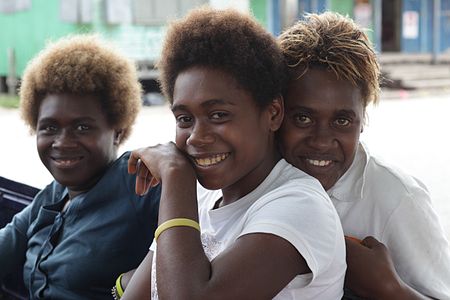
Girls from Papua New Guinea

Papuan people in folk costume in Jakarta

Notable people
Abba Bina, notable businessman
Frans Kaisiepo, 4th Governor of Papua and National Hero of Indonesia
Nitya Krishinda Maheswari, Indonesian badminton player and 2014 Asian Games women's doubles gold medalist
Peter O'Neill, 7th Prime Minister of Papua New Guinea
Freddy Numberi, politician and former Indonesian minister
Raema Lisa Rumbewas, Indonesian weightlifter and silver medalist at 2000 Summer Olympics and 2004 Summer Olympics
Boaz Solossa, Indonesian professional footballer
Michael Somare, former Prime Minister of Papua New Guinea
Heather Watson, English female tennis player
See also


- Koteka Tribal Assembly
- People of New Guinea
- Proto-Australoids
- Papua conflict
- Stéphane Breton (filmmaker)
- Indigenous Australians
- Negrito
References
^ "Kewarganegaraan, Suku Bangsa, Agama, Dan Bahasa Sehari-Hari Penduduk Indonesia". Badan Pusat Statistik. 2010. Retrieved 18 July 2017..mw-parser-output cite.citation{font-style:inherit}.mw-parser-output q{quotes:"""""""'""'"}.mw-parser-output code.cs1-code{color:inherit;background:inherit;border:inherit;padding:inherit}.mw-parser-output .cs1-lock-free a{background:url("//upload.wikimedia.org/wikipedia/commons/thumb/6/65/Lock-green.svg/9px-Lock-green.svg.png")no-repeat;background-position:right .1em center}.mw-parser-output .cs1-lock-limited a,.mw-parser-output .cs1-lock-registration a{background:url("//upload.wikimedia.org/wikipedia/commons/thumb/d/d6/Lock-gray-alt-2.svg/9px-Lock-gray-alt-2.svg.png")no-repeat;background-position:right .1em center}.mw-parser-output .cs1-lock-subscription a{background:url("//upload.wikimedia.org/wikipedia/commons/thumb/a/aa/Lock-red-alt-2.svg/9px-Lock-red-alt-2.svg.png")no-repeat;background-position:right .1em center}.mw-parser-output .cs1-subscription,.mw-parser-output .cs1-registration{color:#555}.mw-parser-output .cs1-subscription span,.mw-parser-output .cs1-registration span{border-bottom:1px dotted;cursor:help}.mw-parser-output .cs1-hidden-error{display:none;font-size:100%}.mw-parser-output .cs1-visible-error{font-size:100%}.mw-parser-output .cs1-subscription,.mw-parser-output .cs1-registration,.mw-parser-output .cs1-format{font-size:95%}.mw-parser-output .cs1-kern-left,.mw-parser-output .cs1-kern-wl-left{padding-left:0.2em}.mw-parser-output .cs1-kern-right,.mw-parser-output .cs1-kern-wl-right{padding-right:0.2em}
^ "Ongoing Adaptive Evolution of ASPM, a Brain Size Determinant in Homo sapiens", Science, 9 September 2005: Vol. 309. no. 5741, pp. 1720–1722.
^ 崎谷満『DNA・考古・言語の学際研究が示す新・日本列島史』(勉誠出版 2009年)(in Japanese)
Further reading
.mw-parser-output .refbegin{font-size:90%;margin-bottom:0.5em}.mw-parser-output .refbegin-hanging-indents>ul{list-style-type:none;margin-left:0}.mw-parser-output .refbegin-hanging-indents>ul>li,.mw-parser-output .refbegin-hanging-indents>dl>dd{margin-left:0;padding-left:3.2em;text-indent:-3.2em;list-style:none}.mw-parser-output .refbegin-100{font-size:100%}
W. G. Lawes (1882), "New Guinea and Its People", Popular Science Monthly
External links
 Media related to People of Papua New Guinea at Wikimedia Commons
 Media related to People of Papua New Guinea at Wikimedia Commons
| Ethnic groups in Indonesia by region | |
|---|---|
Indonesians | |
| Sumatra |
|
| Java |
|
| Kalimantan |
|
| Sulawesi |
|
| Papua |
|
| Lesser Sunda Islands |
|
| Maluku Islands |
|
| Non-indigenous |
|
Authority control  |
|
|---|
 | This article about ethnicity or ethnology is a stub. You can help Wikipedia by expanding it. |


