Tobu Railway
 | |
Native name | 東武鉄道株式会社 |
|---|---|
Type | Public (K.K) |
| Traded as | TYO: 9001 |
| Genre | Rail transport |
| Founded | November 1897 |
| Founder | Michinari Suenobu Rokuro Hara |
| Headquarters | 2-18-12 Oshiage, Sumida-ku, Tokyo , Japan |
Area served | Tokyo, Saitama, Chiba, Gunma, Tochigi |
Key people | Nezu Kaichirō |
| Services | Passenger railway |
| Total assets | ¥1.3 trillion |
| Owner | Yoshizumi Nezu (from 1999) |
Number of employees | 4,659 (As of March 2010[update]) |
| Website | www.tobu.co.jp |

Old Tobu Railway logo used until July 2011
Tobu Railway Co., Ltd. (東武鉄道株式会社, Tōbu Tetsudō Kabushiki-gaisha) is a Japanese commuter railway company in the Greater Tokyo Area as well as an intercity and regional operator in the Kantō region. Excluding the Japan Railways Group companies, Tobu's 463.3 km rail system is the second longest in Japan after Kintetsu. It serves large portions of Saitama Prefecture, Gunma Prefecture and Tochigi Prefecture, as well as northern Tokyo and western Chiba Prefecture.
The Tobu corporate group is also engaged in road transportation (bus/taxi), real estate, and retail. It is the largest investor in the Tokyo Skytree, the tallest structure in Japan. The company is a member of the Mizuho keiretsu.[citation needed]
The name "Tobu" is formed from the kanji for east (東) and Musashi (武蔵), the initial area served.
Contents
1 History
2 Railway network
2.1 Main Lines
2.2 Tobu Tojo Lines
3 Rolling stock
3.1 Express EMUs
3.2 Commuter EMUs
3.3 Steam locomotive
3.4 Withdrawn types
3.4.1 Express EMUs
3.4.2 Commuter EMUs
3.4.3 DMUs
3.4.4 Steam locomotives
4 References
5 External links
History
Tobu is one of the oldest railway companies in Japan. It was established in November 1897 and began operation between Kita-Senju and Kuki in August 1899. The Tojo Railway was founded in 1911 as a separate company, but shared its president and head office with Tobu.[1]
Tobu was the first railway in the Kanto region to adopt quadruple tracks, on the Kita-Senju to Takenotsuka sector in 1974. The Tobu Dobutsu Koen (Tobu Animal Park) opened in 1981.[2]
Railway network

Diagram of the Tobu network, showing main lines to right and Tojo Lines to lower left
Tobu has two isolated networks which are connected by the Chichibu Railway for ferrying of its rolling stock.
The Tobu Main Line network has a tree topology starting at Asakusa Station in Tokyo, with the Isesaki line as the trunk, and the Tobu Kameido Line, Daishi Line, Tobu Urban Park Line, Tobu Sano Line, Koizumi Line, Tōbu Kiryū Line, and Nikkō Line forming the branches, with further branches into the Tobu Utsunomiya Line and Tobu Kinugawa Lines. It offers surcharged, seat-reserved limited express services from Tokyo to Nikkō and Kinugawa.
The Tojo Line runs northwest from Ikebukuro Station in Tokyo to central and western Saitama Prefecture. A branch, the Ogose Line, runs to Ogose from Sakado Station.
Tobu's terminals in Tokyo are at Asakusa Station (Main Line express services), Oshiage Station (most other Main Line services) and Ikebukuro Station (Tojo Line). The Skytree and Isesaki Lines interoperate with the Tokyo Metro Hibiya Line to serve central Tokyo, while the Tojo Line interoperates with the Tokyo Metro Fukutoshin Line, Tokyu Toyoko Line and Minatomirai Line to serve central and southwest Tokyo and Kanagawa Prefecture.
Main Lines
| Name | Symbol | Stations | Length (km) |
|---|---|---|---|
| Skytree Line |  | Asakusa – Tōbu-Dōbutsu-Kōen | 41.0 |
| Kameido Line | Hikifune – Kameido | 3.4 | |
| Daishi Line | Nishiarai – Daishimae | 1.0 | |
| Isesaki Line |  | Tōbu-Dōbutsu-Kōen – Isesaki | 75.1 |
| Sano Line | Tatebayashi – Kuzū | 22.1 | |
| Koizumi Line | Tatebayashi – Nishi-Koizumi, Ōta – Higashi-Koizumi | 12.0 | |
| Kiryū Line | Ōta – Akagi | 20.3 | |
| Nikkō Line |  | Tōbu-Dōbutsu-Kōen – Tōbu Nikkō | 94.5 |
| Utsunomiya Line | Shin-Tochigi – Tōbu Utsunomiya | 24.3 | |
| Kinugawa Line | Shimo-Imaichi – Shin-Fujiwara | 16.2 | |
Urban Park Line (Formerly Noda Line) |  | Ōmiya – Kasukabe – Funabashi | 62.7 |
Tobu Tojo Lines
| Name | Symbol | Stations | Length (km) |
|---|---|---|---|
| Tojo Line |  | Ikebukuro – Yorii | 75.0 |
| Ogose Line | Sakado – Ogose | 10.9 |
Rolling stock
As of 1 April 2016[update], Tobu Railway operates a fleet of 1,890 electric multiple unit (EMU) vehicles, the third largest fleet for a private railway operator in Japan after Tokyo Metro (2,728 vehicles) and Kintetsu (1,905).[3]
Express EMUs
1800 series EMU (introduced 1969)
6050 series EMU (introduced 1985)
300/350 series EMU (introduced 1991)
200/250 series EMU Ryōmō (introduced 1991)
100 series EMU Spacia (introduced 1990)
634 series EMU Skytree Train (introduced 2012)
500 series 3-car EMUs (introduced in April 2017)
Eight new three-car 500 series EMU trains were introduced on limited express services on lines from Asakusa in 21 April 2017.[4]

1800 series

6050 series

350 series Kirifuri limited express

200 series Ryōmō limited express
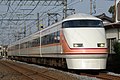
100 series Spacia

634 series Skytree Train
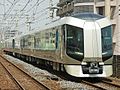
A 500 series EMU in May 2017


Commuter EMUs
8000 series EMU (introduced 1963)
800/850 series EMU
9000 series EMU (introduced 1981)
10000 series EMU (introduced 1983)
20000 series EMU (introduced 1988)
30000 series EMU (introduced 1996)
50000 series EMU (introduced 2005)
60000 series EMU (introduced June 2013)
70000 series EMU (since 7 July 2017)[5]
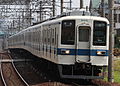
8000 series (refurbished)

9000 series

10000 series

20000 series

30000 series

50000 series
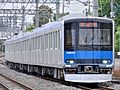
60000 series

70000 series


Steam locomotive
Tobu plans to operate steam-hauled tourist services on the Kinugawa Line from 10 August 2017 using JNR Class C11 steam locomotive C11 207 loaned from JR Hokkaido together with JNR Class DE10 diesel locomotive DE10 1099 purchased from JR East, a fleet of six 12 and 14 series coaches purchased from JR Shikoku, and two Yo 8000 brake vans purchased from JR Freight and JR East.[6]
Withdrawn types
Express EMUs
- 1700/1720 series
- 5700 series
- 6000 series

1720 series

5700 series

6000 series


Commuter EMUs
- 2000 series
- 3000 series
5000 series (1979–2006)- 7300 series
- 7800 series
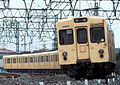
2000 series
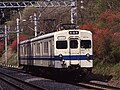
3000 series

5000 series

7300 series

7800 series


DMUs
- KiHa 2000 series

Preserved KiHa 2000 series DMU

Steam locomotives
- Tobu B1 Class 4-4-0 (1898)
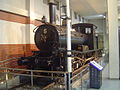
Preserved Tobu Railway B1 Class 4-4-0
References
.mw-parser-output .refbegin{font-size:90%;margin-bottom:0.5em}.mw-parser-output .refbegin-hanging-indents>ul{list-style-type:none;margin-left:0}.mw-parser-output .refbegin-hanging-indents>ul>li,.mw-parser-output .refbegin-hanging-indents>dl>dd{margin-left:0;padding-left:3.2em;text-indent:-3.2em;list-style:none}.mw-parser-output .refbegin-100{font-size:100%}
Terada, Hirokazu (July 2002). データブック日本の私鉄: 全国私鉄149社局掲載 データブック日本の私鉄 [Databook: Japan's Private Railways]. Japan: Neko Publishing. pp. 56–57. ISBN 978-4-87366-874-1..mw-parser-output cite.citation{font-style:inherit}.mw-parser-output .citation q{quotes:"""""""'""'"}.mw-parser-output .citation .cs1-lock-free a{background:url("//upload.wikimedia.org/wikipedia/commons/thumb/6/65/Lock-green.svg/9px-Lock-green.svg.png")no-repeat;background-position:right .1em center}.mw-parser-output .citation .cs1-lock-limited a,.mw-parser-output .citation .cs1-lock-registration a{background:url("//upload.wikimedia.org/wikipedia/commons/thumb/d/d6/Lock-gray-alt-2.svg/9px-Lock-gray-alt-2.svg.png")no-repeat;background-position:right .1em center}.mw-parser-output .citation .cs1-lock-subscription a{background:url("//upload.wikimedia.org/wikipedia/commons/thumb/a/aa/Lock-red-alt-2.svg/9px-Lock-red-alt-2.svg.png")no-repeat;background-position:right .1em center}.mw-parser-output .cs1-subscription,.mw-parser-output .cs1-registration{color:#555}.mw-parser-output .cs1-subscription span,.mw-parser-output .cs1-registration span{border-bottom:1px dotted;cursor:help}.mw-parser-output .cs1-ws-icon a{background:url("//upload.wikimedia.org/wikipedia/commons/thumb/4/4c/Wikisource-logo.svg/12px-Wikisource-logo.svg.png")no-repeat;background-position:right .1em center}.mw-parser-output code.cs1-code{color:inherit;background:inherit;border:inherit;padding:inherit}.mw-parser-output .cs1-hidden-error{display:none;font-size:100%}.mw-parser-output .cs1-visible-error{font-size:100%}.mw-parser-output .cs1-maint{display:none;color:#33aa33;margin-left:0.3em}.mw-parser-output .cs1-subscription,.mw-parser-output .cs1-registration,.mw-parser-output .cs1-format{font-size:95%}.mw-parser-output .cs1-kern-left,.mw-parser-output .cs1-kern-wl-left{padding-left:0.2em}.mw-parser-output .cs1-kern-right,.mw-parser-output .cs1-kern-wl-right{padding-right:0.2em}
^ "明治28年~45年". Tobu Railway. Retrieved 28 April 2015.
^ "昭和41年~63年". Tobu Railway. Retrieved 28 April 2015.
^ 私鉄車両編成表 2016 私鉄車両編成表 2016 [Private Railway Rolling Stock Formations - 2016] (in Japanese). Japan: Kotsu Shimbunsha. 25 July 2016. pp. 213–214. ISBN 978-4-330-70116-5.
^ 2017年4月21日(金)ダイヤ改正を実施! [Revised timetable to be introduced on Friday 21 April 2017] (PDF). News release (in Japanese). Japan: Tobu Railway. 18 January 2017. Archived from the original (pdf) on 19 January 2017. Retrieved 19 January 2017.
^ 東武70000系が営業運転を開始 [Tobu 70000 series enters revenue service]. Japan Railfan Magazine Online (in Japanese). Japan: Koyusha Co., Ltd. 8 July 2017. Archived from the original on 9 July 2017. Retrieved 9 July 2017.
^ 東武鬼怒川線で復活するSL「大樹」の営業運転開始日を2017年8月10日(木)に決定! ["Taiju" steam locomotive on Tobu Kinugawa Line to enter service on Thursday 10 August 2017] (PDF). News release (in Japanese). Japan: Tobu Railway. 18 January 2017. Archived from the original (pdf) on 19 January 2017. Retrieved 19 January 2017.
External links
 | Wikimedia Commons has media related to Tobu Railway. |
Tobu Group website (in Japanese)
Mass transit in the Greater Tokyo Area | |||||||
|---|---|---|---|---|---|---|---|
 JR East lines JR East linespassing through Central Tokyo |
| ||||||
 Tokyo Metro lines Tokyo Metro lines |
| ||||||
 Toei subway lines Toei subway lines |
| ||||||
 Yokohama Municipal Yokohama Municipal |
| ||||||
| JR East lines in satellite cities or suburbs |
| ||||||
 Keikyu Keikyu |
| ||||||
 Keio Keio |
| ||||||
 Keisei Keisei |
| ||||||
 Odakyu Odakyu |
| ||||||
 Seibu Seibu |
| ||||||
 Sotetsu Sotetsu |
| ||||||
 Tobu Tobu |
| ||||||
 Tokyu Tokyu |
| ||||||
| Other commuter rail lines |
| ||||||
| Monorails and light transit |
| ||||||
| Hinterland |
| ||||||
Funiculars and aerial lifts |
| ||||||
 Bus Bus |
| ||||||
| Public ferries |
| ||||||
| Major terminals |
| ||||||
| Miscellaneous |
| ||||||
| Construction projects |
| ||||||
| |||||||
 Yamanote
 Keihin-Tōhoku - Negishi
 Chūō-Sōbu Local
 Chūō Rapid
 Yokosuka - Sōbu Rapid
 Utsunomiya & Takasaki -
  Tōkaidō
 Saikyo
 Shonan–Shinjuku
 Jōban Rapid
 Jōban Local
 Keiyō
Keiyō Chiyoda
 Fukutoshin
 Ginza
Ginza Hibiya
 Marunouchi
 Namboku
 Tōzai
Tōzai Yūrakuchō
 Hanzōmon
 Asakusa
 Ōedo
Ōedo Mita
Mita Shinjuku
 Blue
Blue Green
Green Musashino
 Yokohama
 Nambu
Nambu Tsurumi
 Gotemba (
  JR Central)
 Keikyū Main
 Keio
Keio Inokashira
 Keisei Main
 Narita Sky Access
 Odawara
 Enoshima
 Tama
Tama Ikebukuro
 Seibu Shinjuku
 Kokubunji
 Tamagawa
 Tamako
 Sotetsu Main
 Skytree
 Isesaki
 Nikkō
Nikkō Urban Park
 Tōjō
Tōjō Den-en-toshi
 Ikegami
 Meguro
 Oimachi
 Tokyu Tamagawa
 Toyoko
 Kodomonokuni
 Hokusō
 Kantō
Kantō Rinkai
 Saitama Rapid
 Shibayama
 Shin-Keisei
 Tōyō Rapid
 Tsukuba Express
 Minatomirai 21
 Chiba Monorail
 Disney Resort
 Shōnan Monorail
 Tama Monorail
 Tokyo Monorail
 New Shuttle
 Kanazawa Seaside
 Nippori-Toneri
 Seibu Yamaguchi
 Yurikamome
 Enoden
 Setagaya
 Arakawa
 Ōyama Cable Car
 (Takao Tozan Railway
 Rail
Rail Airports
 Ports
Ports Heliports
 Shinkansen
 Nikkei 225 companies of Japan Nikkei 225 companies of Japan | |
|---|---|
|


