9M120 Ataka
| 9M120 Ataka AT-9 Spiral-2 | |
|---|---|
 9M120 missile with tandem HEAT warhead | |
| Type | Anti-tank guided missile |
| Place of origin | Soviet Union |
| Service history | |
| In service | 1985–present |
| Used by | See Operators |
| Production history | |
| Designer | KBM[1] |
| Designed | 1980 |
| Manufacturer | Degtyarev plant[2] |
| Produced | 1980s–present |
| Variants | See Variants |
| Specifications (9M120 Ataka[3]) | |
| Weight | 49.5 kg (109 lb) |
| Length | 1,830 mm (72 in) |
| Diameter | 130 mm (5.1 in) |
| Warhead | HEAT Tandem warhead |
| Warhead weight | 7.4 kg (16 lb) |
Detonation mechanism | Impact |
| Wingspan | 360 mm (14 in) |
Operational range | 0.4–6 km (0.25–3.73 mi) |
| Flight ceiling | 0–4,000 m (2.5 mi) |
| Speed | 550 m/s (1,800 ft/s; Mach 1.6) (maximum) 400 m/s (1,300 ft/s; Mach 1.2) (average) |
Guidance system | Radio command link SACLOS |
| Accuracy | 0.65–0.9 Hit probability against an MBT from a distance of 4 km.[3] |
Launch platform | Armored fighting vehicles and helicopters |
The 9M120 Ataka (Russian: Атака; Attack) is an anti-tank guided missile (ATGM) originating from the Soviet Union.[3] The NATO reporting name of the 9M120 missile is the AT-9 Spiral-2. It is the next major generation in the 9K114 Shturm (AT-6 Spiral) family. The missile has radio command guidance and is also a Beam riding SACLOS. This missile's primary variant was designed to defeat tanks with composite armour and explosive reactive armor. The 9M120 Ataka system is often confused with the 9K121 Vikhr system, despite being different weapons systems developed by different companies. The former was designed by the KBM machine-building design bureau and manufactured by the Degtyarev plant. According to the Stockholm International Peace Research Institute, Russia exported the Ataka ATGM to Iran, Kazakhstan, and Slovenia.[4]
Contents
1 Development
2 Description
3 Variants
4 General specifications
5 Operators
5.1 Current operators
5.2 Possible operators
5.3 Former operators
6 References
7 External links
Development
The AT-9 missile was developed by the Kolomna engineering design bureau, located in Kolomna.[1] This company already designed previous ATGMs, such as the AT-3 "Sagger" and AT-6 "Spiral" missiles. The design work began in the mid 1980s. The Ataka ATGM was designed as a successor model to the AT-6 "Spiral", which was introduced in the late 1970s. The AT-9 is a further development of the AT-6. Compared to its predecessor, the AT-9 is more resistant to electronic countermeasures, and has a greater hit accuracy and longer reach. The newly developed warhead allows for increased penetration power and effectiveness against explosive reactive armor. The first units were delivered in 1985 to the Soviet armed forces.[5]
The missile has often been confused in the west with the 9A1472 Vikhr dual-purpose laser beam riding missile used on the Kamov helicopters and Sukhoi attack aircraft (as well as some Ukrainian Mi-24/35 upgrades). These systems are completely unrelated in their design and are in fierce competition.
Description
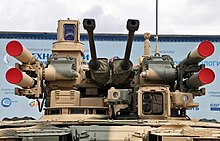
The primary armaments of the BMPT include four Ataka-T missiles with two mounted on each side.[6]
The Ataka missile is stored in a glass reinforced plastic tube, which also acts as its launcher. The missile is reported to be considerably faster than the 9K114 Shturm, with longer range than the original version. It still uses radio command guidance, but the system has been improved when compared to the earlier 9K114 Shturm.
The system is carried by the multiple kinds of helicopters including the Mi-28 and Mi-35. It is also offered for ground vehicles like the BMPT and the 9P149.
There are three main missiles that are compatible with the launch system. The first is a two-stage anti-armour weapon that features a tandem warhead for dealing with add-on armor. The second variant of the missile – designated as 9M120F – has a thermobaric warhead for use against infantry positions and bunkers. The third variant of the 9M120 Ataka is the 9M220, which features a proximity fused expanding rod warhead, providing the missile with air-to-air capability against low- and slow-flying aircraft.
Variants

The 9P149 combat vehicle carries 12 Ataka missiles.[2]
9M120 Ataka "AT-9 Spiral-2" SACLOS radio command guidance missile.[3]
9M120 – This variant features a tandem HEAT warhead to defeat current and future armored fighting vehicles equipped with ERA.
9M120F – This variant uses a thermobaric warhead for greater effect against buildings, unarmored targets, and bunkers.
9M220O – This variant is included with an expanding rod warhead for use against helicopters. It is equipped with a proximity fuse to destroy aircraft, and detonates its fragmentation warhead when less than four meters from the target.
9M120M – A modernized variant with an extended range of 8,000 m. The improved warhead can penetrate over 950 mm of RHA after ERA.
9M120D – An improved variant with a range of 10 km
9M120-1 Ataka – Upgraded Ataka missiles used by Ataka-T GWS.[7][8]
General specifications

The Mi-28 attack helicopter carries 16 Ataka missiles for anti-tank missions.[2]
| Designation | Description | Length | Diameter | Wingspan | Launch weight | Warhead | Armor penetration (RHA) | Range | Speed |
|---|---|---|---|---|---|---|---|---|---|
| 9M120 | Original variant | 1,830 mm (72 in) | 130 mm (5.1 in) | 360 mm (14 in) | 49.5 kg (109 lb) | 7.4 kg (16 lb) Tandem HEAT | 800 mm (31 in) after ERA | 0.4–6 km (0.25–3.73 mi) | 550 m/s (1,800 ft/s; Mach 1.6) (Top speed) 400 m/s (1,300 ft/s; Mach 1.2)(Average) |
| 9M120F | Anti-personnel variant | Thermobaric warhead with 9.5 kg (21 lb) TNT equivalent | N/A | 1–5.8 km (0.62–3.60 mi) | |||||
| 9M220O | Anti-air variant | Proximity Fuse | 0.4–7 km (0.25–4.35 mi) | ||||||
| 9M120M | Modernized anti-tank variant | 7.4 kg (16 lb) Tandem HEAT | 950 mm (37 in) after ERA | 0.8–8 km (0.50–4.97 mi) |
Operators

Map with 9M120 operators in blue with former operators in red
Current operators
 Algeria

Algerian Air Force – used in helicopters Mi-24MKIII[9] and Mil Mi-28.[10]
Algerian Ground Forces – used in BMPT Terminator .
 Brazil

Brazilian Air Force – used in helicopters Mil Mi-35.
 India
India
 Indonesia


Indonesian Army – Used in Mi-35P Attack Helicopter.
 Iran[4]

Iranian Air Force – In 1999, 500 AT-6 Spiral missiles were ordered for the Mi-171Sh. The delivery started in 2000 and ended in 2003 with some of these missiles possibly being AT-9 Spiral-2s.
 Kazakhstan[4]

Armed Forces of the Republic of Kazakhstan – 120 missiles were ordered in 2010 for the BMPT tanks support vehicle. In 2011, 40 were delivered.
 Russia

Russian Armed Forces – Operated on a wide range of vehicles ranging from helicopters to ATGM missiles carriers.
 Slovenia[4]

Slovenian Armed Forces – Six launchers were ordered in 2009 and mounted on patrol boat "Triglav" the following year.
 Venezuela

Venezuelan Army Aviation used in helicopters Mil Mi-35M2
Possible operators
 North Korea[11]

Former operators
 Soviet Union – Passed on to successor states.

References
^ ab "Protivotankovyye raketnyye kompleksy". KBM Design Bureau of Machine Building (in Russian). Retrieved 18 July 2014..mw-parser-output cite.citation{font-style:inherit}.mw-parser-output q{quotes:"""""""'""'"}.mw-parser-output code.cs1-code{color:inherit;background:inherit;border:inherit;padding:inherit}.mw-parser-output .cs1-lock-free a{background:url("//upload.wikimedia.org/wikipedia/commons/thumb/6/65/Lock-green.svg/9px-Lock-green.svg.png")no-repeat;background-position:right .1em center}.mw-parser-output .cs1-lock-limited a,.mw-parser-output .cs1-lock-registration a{background:url("//upload.wikimedia.org/wikipedia/commons/thumb/d/d6/Lock-gray-alt-2.svg/9px-Lock-gray-alt-2.svg.png")no-repeat;background-position:right .1em center}.mw-parser-output .cs1-lock-subscription a{background:url("//upload.wikimedia.org/wikipedia/commons/thumb/a/aa/Lock-red-alt-2.svg/9px-Lock-red-alt-2.svg.png")no-repeat;background-position:right .1em center}.mw-parser-output .cs1-subscription,.mw-parser-output .cs1-registration{color:#555}.mw-parser-output .cs1-subscription span,.mw-parser-output .cs1-registration span{border-bottom:1px dotted;cursor:help}.mw-parser-output .cs1-hidden-error{display:none;font-size:100%}.mw-parser-output .cs1-visible-error{font-size:100%}.mw-parser-output .cs1-subscription,.mw-parser-output .cs1-registration,.mw-parser-output .cs1-format{font-size:95%}.mw-parser-output .cs1-kern-left,.mw-parser-output .cs1-kern-wl-left{padding-left:0.2em}.mw-parser-output .cs1-kern-right,.mw-parser-output .cs1-kern-wl-right{padding-right:0.2em}
^ abc "V.A. Degtyarev Plant: 9M120 (9M120F) Ataka Missile". Open Joint Stock Company V.A. Degtyarev Plant. Retrieved 18 July 2014.
^ abcd "9M120 ATAKA-B". airwar.ru (in Russian). Retrieved 18 July 2014.
^ abcd "SIPRI Arms Transfers Database". Stockholm International Peace Research Institute. Retrieved 18 July 2014.
^ Hull, A.W.; Markov, D.R.; Zaloga, S.J. (1999). Soviet/Russian Armor and Artillery Design Practices 1945 to Present. Darlington Production. ISBN 1-892848-01-5.
^ "UralVagonZavod – Boyevaya mashina ognevoy podderzhki Terminator". UralVagonZavod (in Russian). Archived from the original on 25 June 2014. Retrieved 5 July 2014.
^ "ATAKA-T guided weapon system | JOINT STOCK COMPANY RESEARCH AND PRODUCTION CORPORATION KONSTRUKTORSKOYE BYURO MASHYNOSTROYENIYA".
^ "BMP-3M with Ataka 9m120-1 anti-tank guided missile Army-2017 12508172 | Army-2017 Show Daily News Coverage Report | Defence security military exhibition 2017 daily news category".
^ http://www.lematindz.net/news/4644-des-helicopteres-russes-pour-lalgerie.html
^ http://red-stars.org/spip.php?article55
^ http://www.military-today.com/missiles/ataka.htm
External links
 | Wikimedia Commons has media related to 9M120 Ataka. |
SHTURM-ATAKA Russian ATGM! (English subtitles) on YouTube
ПТУР «Атака». Эксклюзивные кадры стрельбы (The antitank guided missile Ataka) on YouTube


