Trimeresurus gramineus
Trimeresurus gramineus | |
|---|---|
 | |
Conservation status | |
 Least Concern (IUCN 3.1)[1] | |
Scientific classification  | |
| Kingdom: | Animalia |
| Phylum: | Chordata |
| Class: | Reptilia |
| Order: | Squamata |
| Suborder: | Serpentes |
| Family: | Viperidae |
| Genus: | Trimeresurus |
| Species: | T. gramineus |
Binomial name | |
Trimeresurus gramineus (Shaw, 1802) | |
 | |
Synonyms | |
| |
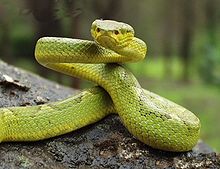
Trimeresurus gramineus (bamboo pit viper, Indian green pit viper,common green pit viper)[4] is a venomous pit viper species found only in southern India. No subspecies are currently recognized.[5] It is the type species for the genus Trimeresurus.[2]
Contents
1 Description
2 Common names
3 Geographic range
4 Habitat
5 venom type
6 Behaviour
7 Diet
8 Reproduction
9 See also
10 References
11 Further reading
12 External links
Description

Head
Rostral scale as deep as broad or broader than deep; upper head-scales small, smooth, imbricate; supraocular scale narrow, rarely broken up; internasals in contact or separated by one or two scales; 8 to 13 scales on a line between the supraoculars; usually one or two, rarely three, series of scales between the suboculars and the labials; 9 to 12 upper labials, second usually forming the anterior border of the loreal pit, third largest; temporal scales smooth.
Dorsal scales more or less distinctly keeled, in 21 (rarely 19 or 23) rows. Ventrals 145–175; anal scale entire; subcaudals in two rows 53–76.
Upper parts usually bright green, rarely yellowish, greyish, or purplish brown, with or without black, brown, or reddish spots; usually a light, white, yellow, or red streak along the outer row of scales; end of tail frequently yellow or red; lower parts green, yellow, or whitish.[6]
Grows to a total length of 3.25 feet (0.99 m); tail 5.5 inches (14 cm).[6]

T. gramineus, Raajmachi, Lonavala

Common names

Trimeresurus gramineus (satara, Maharashtra)
Bamboo pit viper,[7][8] Indian tree viper,[9] bamboo snake, Indian green tree viper, green tree viper,[10] bamboo viper,[11] bamboo pitviper,[12]boodro pam, grass-green snake,[13] green pit viper.[14]
Geographic range
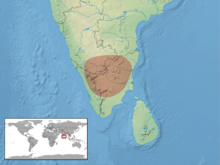
The range of this species has been restricted to southern India. It is also rarely seen near Harishchandragad and some other mountain ranges of Western Ghats aka Sahyadris in Maharashtra. This snake is also found in the eastern region of India spanning from Odisha, Jharkhand and West Bengal
The type locality is "Vizagapatam, India", which is based on Russell (1796).[2]
Habitat
It is found in bamboo groves and forests, usually near streams.[14]
venom type
Haemotoxic
Behaviour
T. gramineus is arboreal and nocturnal. When threatened, it is aggressive and does not hesitate to bite.[14]
Diet
It feeds on lizards and birds.[14]
Reproduction
T. gramineus is ovoviviparous. Adult females gives birth to 6 to 11 young ones, which measure up to 4.5inches in length.
See also
- List of crotaline species and subspecies
- Trimeresurus by common name
- Trimeresurus by taxonomic synonyms
- Crotalinae by common name
- Crotalinae by taxonomic synonyms
- Snakebite
References
^ Srinivasulu, C.; Srinivasulu, B.; Deepak, V.; Achyuthan, N.S.; Das, A.; Kulkarni, N.U. (2013). "Trimeresurus gramineus". The IUCN Red List of Threatened Species. IUCN. 2013: e.T178245A1528655. doi:10.2305/IUCN.UK.2013-1.RLTS.T178245A1528655.en. Retrieved 22 January 2017..mw-parser-output cite.citation{font-style:inherit}.mw-parser-output q{quotes:"""""""'""'"}.mw-parser-output code.cs1-code{color:inherit;background:inherit;border:inherit;padding:inherit}.mw-parser-output .cs1-lock-free a{background:url("//upload.wikimedia.org/wikipedia/commons/thumb/6/65/Lock-green.svg/9px-Lock-green.svg.png")no-repeat;background-position:right .1em center}.mw-parser-output .cs1-lock-limited a,.mw-parser-output .cs1-lock-registration a{background:url("//upload.wikimedia.org/wikipedia/commons/thumb/d/d6/Lock-gray-alt-2.svg/9px-Lock-gray-alt-2.svg.png")no-repeat;background-position:right .1em center}.mw-parser-output .cs1-lock-subscription a{background:url("//upload.wikimedia.org/wikipedia/commons/thumb/a/aa/Lock-red-alt-2.svg/9px-Lock-red-alt-2.svg.png")no-repeat;background-position:right .1em center}.mw-parser-output .cs1-subscription,.mw-parser-output .cs1-registration{color:#555}.mw-parser-output .cs1-subscription span,.mw-parser-output .cs1-registration span{border-bottom:1px dotted;cursor:help}.mw-parser-output .cs1-hidden-error{display:none;font-size:100%}.mw-parser-output .cs1-visible-error{font-size:100%}.mw-parser-output .cs1-subscription,.mw-parser-output .cs1-registration,.mw-parser-output .cs1-format{font-size:95%}.mw-parser-output .cs1-kern-left,.mw-parser-output .cs1-kern-wl-left{padding-left:0.2em}.mw-parser-output .cs1-kern-right,.mw-parser-output .cs1-kern-wl-right{padding-right:0.2em}
^ abc McDiarmid RW, Campbell JA, Touré T. 1999. Snake Species of the World: A Taxonomic and Geographic Reference, Volume 1. Herpetologists' League. 511 pp.
ISBN 1-893777-00-6 (series).
ISBN 1-893777-01-4 (volume).
^ The Reptile Database. www.reptile-database.org.
^ http://www.indiansnakes.org/content/bamboo-pit-viper-0
^ "Trimeresurus gramineus". Integrated Taxonomic Information System. Retrieved 27 September 2006.
^ ab Boulenger GA. 1890. The Fauna of British India, Including Ceylon and Burma. Reptilia and Batrachia. Secretary of State for India in Council. (Taylor and Francis, Printers.) London. xviii + 541 pp. (Trimeresurus, p. 425 & Trimeresurus gramineus, pp. 429–430.)
^ Khaire, N. 2006. A Guide to the Snakes of Maharashtra, Goa and Karnataka. Indian Herpetological Society. Pune, India. (Photographic guide with 61 species.)
^ Smith MA. 1943. The Fauna of British India, Ceylon and Burma, Including the Whole of the Indo-Chinese Sub-region. Reptilia and Amphibia. Vol. III. – Serpentes. Secretary of State for India. (Taylor & Francis, Printers). London. xii + 583 pp., 166 figures. (Trimeresurus gramineus, pp. 515–517, Fig. 164.)
^ Mehrtens JM. 1987. Living Snakes of the World in Color. New York: Sterling Publishers. 480 pp.
ISBN 0-8069-6460-X.
^ U.S. Navy. 1991. Poisonous Snakes of the World. US Govt. New York: Dover Publications Inc. 203 pp.
ISBN 0-486-26629-X.
^ Parker HW, Grandison AGC. 1977. Snakes – a natural history. Second Edition. British Museum (Natural History) and Cornell University Press. 108 pp. 16 plates. LCCCN 76-54625.
ISBN 0-8014-1095-9 (cloth),
ISBN 0-8014-9164-9 (paper).
^ Gumprecht A, Tillack F, Orlov NL, Captain A, Ryabov S. 2004. Asian Pitvipers. GeitjeBooks Berlin. 1st Edition. 368 pp.
ISBN 3-937975-00-4.
^ Shaw. 1802. p. 420.
^ abcd Das, Indraneil. 2002. A Photographic Guide to Snakes and Other Reptiles of India. Ralph Curtis Books. Sanibel Island, Florida. 144 pp.
ISBN 0-88359-056-5. (Trimeresurus gramineus, p. 65.)
Further reading
.mw-parser-output .refbegin{font-size:90%;margin-bottom:0.5em}.mw-parser-output .refbegin-hanging-indents>ul{list-style-type:none;margin-left:0}.mw-parser-output .refbegin-hanging-indents>ul>li,.mw-parser-output .refbegin-hanging-indents>dl>dd{margin-left:0;padding-left:3.2em;text-indent:-3.2em;list-style:none}.mw-parser-output .refbegin-100{font-size:100%}
Cantor, T.E. 1839. Spicilegium serpentium indicorum [parts 1 and 2]. Proc. Zool. Soc. London 7: 31–34, 49–55.- Gumprecht, A.; Tillack, F.; Orlov, N.L.; Captain, A. & Ryabow, S. 2004. Asian Pit Vipers. Geitje Books. Berlin. 368 pp.
Russell, P. 1796. An Account of Indian Serpents, Collected on the Coast of Coromandel; Containing Descriptions and Drawings of Each Species, Together with Experiments and Remarks on Their Several Poisons. George Nicol. London. viii + 91 pp. + Plates I.- XLVI.
Shaw, G. 1802. General Zoology, or Systematic Natural History: Vol. III., Part II. G. Kearsley. (Thomas Davison, Printer). London. iv + pp. 313–615 + Plates 87–140. ("Coluber Gramineus", pp. 420–421.).
Stejneger, L. 1927. The green pit viper, Trimeresurus gramineus, in China. Proceedings of the United States National Museum 72 (19): 1–10.
External links
 | Wikimedia Commons has media related to Trimeresurus gramineus. |
Trimeresurus gramineus at the Reptarium.cz Reptile Database. Accessed 6 December 2007.


